The networks we use to communicate across fields and distances, to find our friends and learn from people unlike ourselves—and to organize ourselves to respond to acute crises and long, grinding institutional failures—are the same networks that are making so many of us miserable and/or deranged.
Posts in: civic
Not Built For This is a 6-part series from 99% Invisible. It explores how climate change is laying bare the vulnerabilities in the American built environment and how communities across the country have been left to bootstrap their own survival.
American suburbs are full of ugly, empty, liminal spaces: spaces you are not meant to linger in or enjoy. They’re the creepy hallways of the built environment, and you can’t feel comfortable traversing them unless you’re zooming past them in a car.
American Suburbs Are a Horror Movie and We’re the Protagonists
America’s 7-Elevens to become ‘Japanese style’: “Japan’s 7-Eleven locations – referred to as konbini – have a different vibe. There, they put a focus on “tantalizing food,” according to TODAY. Items found at Japanese 7-Eleven stores include onigiri (rice balls), fried chicken, sushi, egg sandwiches, fresh pastries, mochi and hot bar items”
The internet isn’t for humans anymore. Bots use the internet more than we do; use shapes design.
If the web is now a metaphorical barren wasteland, pillaged by commercial interests and growth-at-all-costs management consultants, then I’m all the more motivated to keep my little patch of land lush, and green, and filled with rainbow flowers.
— My own little patch - Rach Smith
The scale of the algorithm exceeds even our own understanding; its returns benefit only its owners and leave the rest of us awash in noise and bereft of understanding.
— Unscalable, Hand-Crafted Lists of Links - Christopher Butler
Every place I’m from is gone because it’s not just a place, it’s a place at a certain time. It would take a time machine to go back.
— Should I move back to France? - Mike Monteiro
How a Connecticut middle school won the battle against cellphones (🎁 link)
Gabe Silver, another eighth-grader, echoed that sentiment. When the pouches first arrived, “everyone was miserable and no one was talking to each other,” he said. Now he can hear the difference at lunch and in the hallways. It’s louder. Students are chatting more “face to face, in person,” Gabe said. “And that’s a crucial part of growing up.”
I know there has been pushback against The Anxious Generation’s use of research, but I tend to agree with Zoë Schiffer from Platformer. Too much phone time (for kids or adults) just feels bad:
At the same time, we shouldn’t set aside the lived experiences of so many everyday smartphone users. For many of us, constant connectivity feels bad, and doomscrolling can heighten feelings of anxiety and depression. Meanwhile, getting outside and spending time with loved ones face to face can be the antidote to despair. I’m sympathetic to researchers who call attention to that dynamic, even if disputes remain about which claims are grounded in unassailable evidence.
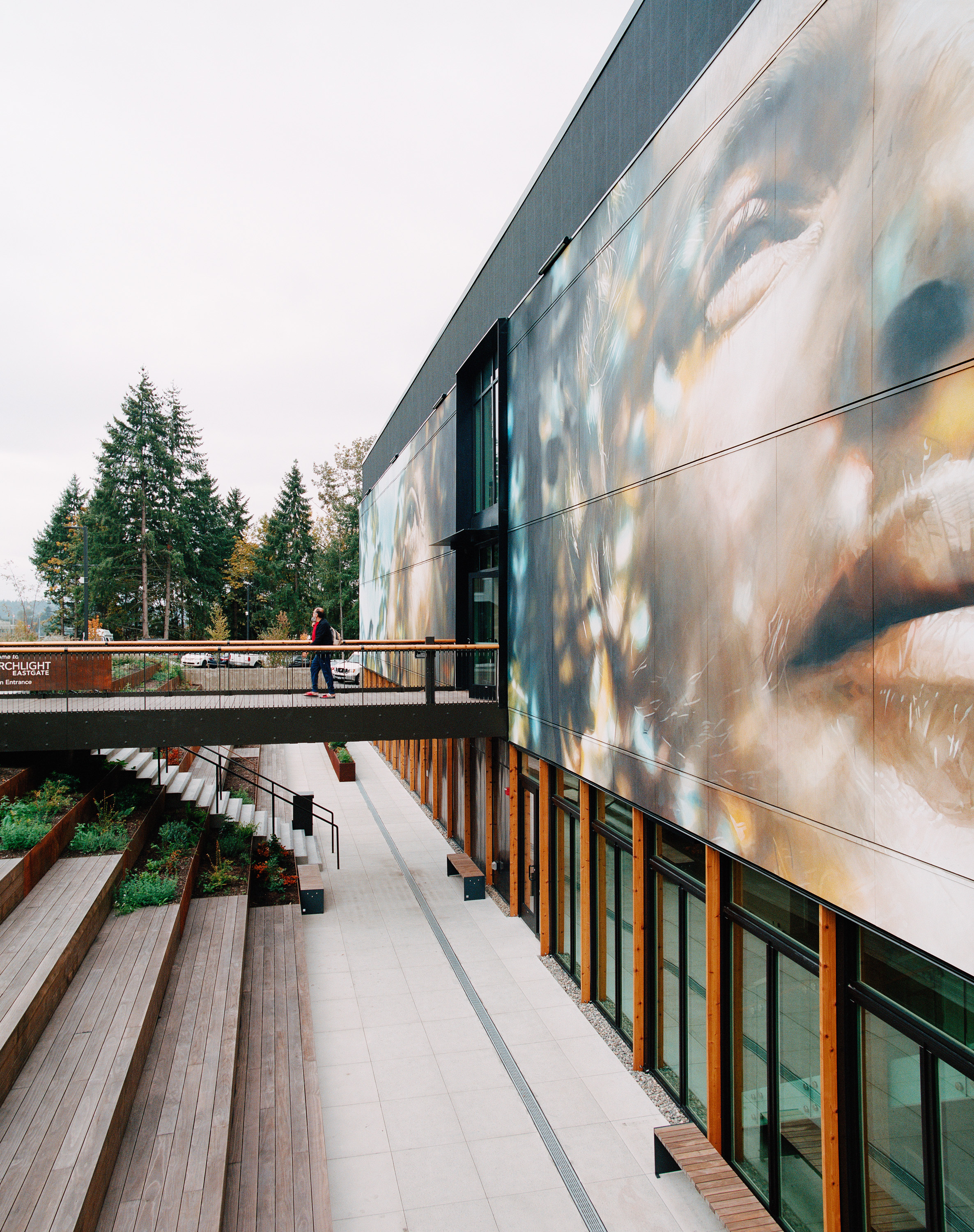
They Didn’t Just Want to Build a Housing Shelter. They Wanted to Shift Public Perception:
Changing the way the public perceives shelters informed the design. From the nearby highway, the first glimpse you get of the structure includes an impressive mural by Australian artist Guido van Helten stretched across its 3,000-square-foot facade. A passerby might think this is an art museum, a shop, or possibly a school.